
Kai's Learning Assistant
On-demand cognitive support for every learner, all course long
Live for learners today. Every assessed learner describes a task and gets a strategy built around how they think, whenever they need it.
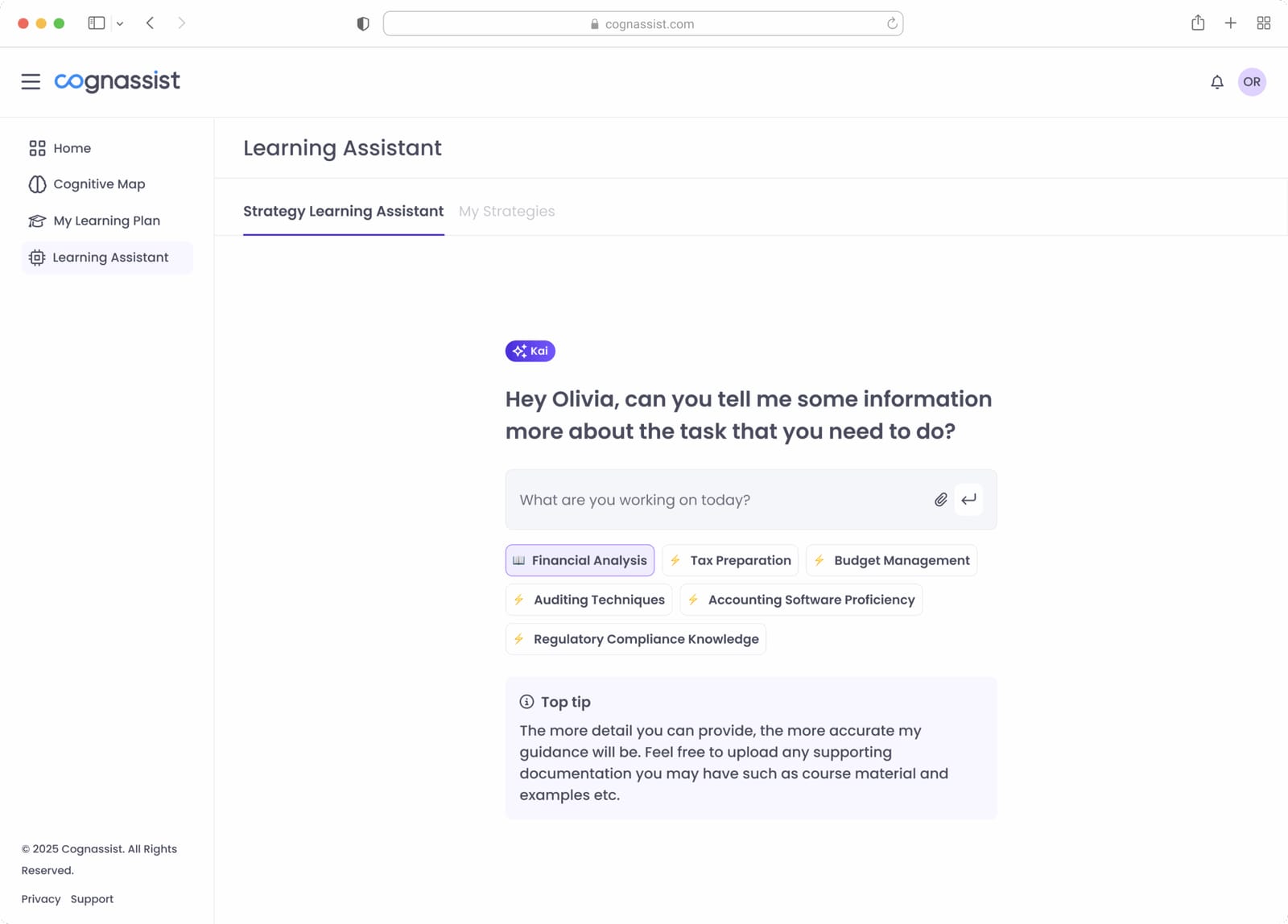
Describe a task, get a strategy built around how you think
A learner types in a real task, like a 2,000-word report or a presentation. Kai returns a detailed, scaffolded strategy structured to their own cognitive profile, not generic study tips.
- A Cognition Alignment panel explains why each approach works for that learner
- Every strategy saves to a personal library to return to and reuse
- Kai gives learning strategies, not a diagnosis
Support that stays with every learner, not just the few with an identified need
For a learner, Kai is simply always there. It is one tap away the night before a deadline, not only in a scheduled session, and it does not disappear when a support plan ends. Every assessed learner has it, whether or not a need was ever identified, so the help follows them through the whole course, not just a moment of it.
- There on demand, 24/7, from the first week to the final assessment
- Still there after a proactive plan ends, so support does not stop the moment a plan does
- Around four fresh, cognition-aware modules land each month to explore, with no tutor action needed
Inclusion at scale
Whole-cohort inclusion, embedded in the learner experience
For a provider, Kai turns inclusion from a service for a subset into something every assessed learner experiences today, across FE, apprenticeship and HE. That is a whole-provision inclusion culture you can point to, not a promise for a minority.
A culture every learner feels
Because Kai reaches the whole cohort, inclusion becomes something learners experience day to day. It helps you evidence a whole-provision approach, not support reserved for an identified-need minority.
Inclusion spend you can defend
One tool that serves every learner is easier to justify than a point solution for a subset, and its value is visible across the whole provision rather than a small slice of it.
Pressure off stretched specialists
Learners on the monitoring pathway get task-level help on demand, so routine questions need not all become tutor or specialist escalations.
This is inclusion built into everyday learning: evidence of a whole-provision culture rather than a tool for the identified-need few.
How Kai works
See how Kai coaches a learner through a task
Kai listens to the task, then builds a step-by-step strategy shaped by the learner's own cognitive profile. It coaches through the work; it produces learning strategies, never a diagnosis or clinical verdict. The exchange below is illustrative.
- Scaffolded and step-by-step, not a generic answer
- Shaped by the learner's own cognitive profile
- Saved to the learner's library to reuse next time
I've got a 2,000-word report due and I don't know where to start.
Let's build a plan around how you work best. You take in detailed information more easily in short bursts, so we'll split this into three focused sessions instead of one long sitting.
That helps. What do I do first?
Session one: map the report into five headings and write one line under each. No polished writing yet, just the structure. I'll save this strategy so you can pick it up next time.
Why it is different
Personalised to a validated cognitive profile, not generic AI advice
Every Kai strategy is aligned to the learner's own cognitive profile from the Cognassist cognitive assessment, a validated, performance-based measure. The Cognition Alignment panel shows the tie. That grounding in a real profile is what a generic chatbot cannot do, and, paired with support that is on for every learner, it is the reason to choose Cognassist.
- Grounded in the Cognassist cognitive assessment, a validated, performance-based measure
- The Cognition Alignment panel ties each strategy back to the learner's profile
- A generic AI assistant has no validated profile to personalise around
FAQ
Common questions about Kai
Is Cognassist only for SEND learners?
No. Kai is available to every assessed learner in a licensed institution, whether or not a need has been identified. It is not a SEND-only tool; it extends cognition-aware support to the whole cohort.Does a learner lose Kai when they step off support?
No. Kai is retained after a learner steps off proactive support, an always-on backstop that stays with them for the rest of their course.Is Kai a diagnosis?
No. Kai produces learning strategies, not clinical conclusions. A cognitive profile is a signal for learning support; it is not a diagnosis and does not by itself establish disability under the Equality Act 2010.How is a Kai strategy personalised?
Through the Cognition Alignment panel, which ties each strategy to the learner's own cognitive profile from the Cognassist cognitive assessment.Is there a tutor-facing version of Kai?
A tutor-facing Kai is on our roadmap and not yet built. We will not present it as available until it is. Today, Kai is a learner-facing assistant.
See Kai working across your whole cohort
Book a demo and see how every assessed learner gets on-demand, cognition-aware support, all course long.